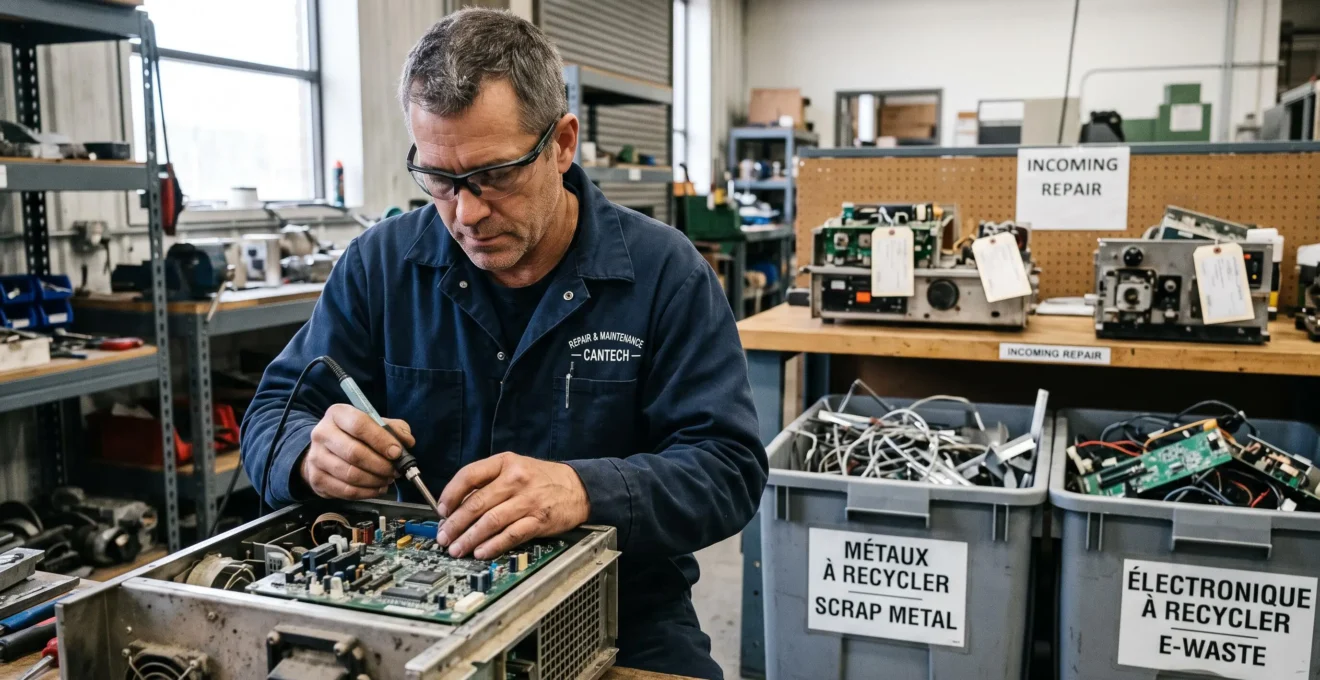
The circular economy reduces waste by keeping products, components, and materials in use for as long as their condition and utility allow. Rather than systematically replacing used equipment, it prioritizes demand reduction, repair, reuse, refurbishment, and, when these options are no longer viable, recycling.
This approach can also generate economic value. A company that reuses its equipment avoids new purchases, curbs disposal costs, and can develop maintenance or resale revenue streams. Consumers can extend the lifespan of their goods while cutting replacement expenditures.
In Canada, however, these opportunities come with concrete constraints: labor costs, transportation distances, safety standards, secondary market demand, and provincial regulatory mandates. Circularity therefore does not automatically guarantee a financial or environmental net gain. Its viability depends on the specific resources involved, the operational steps required to recover them, and how much additional operating life they can deliver.
Circular economy: Three core principles
- Extending the use of a functional or repairable product preserves substantially more utility and value than immediately breaking it down into recycled commodities.
- A reuse initiative must begin with an audit of available assets and a rigorous comparison between recovery, repair, and replacement costs.
- Value creation must be measured: realized cost savings, net revenue, resources actually put back into circulation, and avoided environmental impacts.
- Why Do Repair and Reuse Often Matter More Than Recycling?
- How to Identify Reusable Resources Within a Business
- Repair, Refurbish, or Recycle: Which Option Preserves the Most Value?
- What Hidden Costs Can Undermine a Reuse Program?
- When Should a Company Integrate Circularity Into Its Business Model?
- How to Compare the Environmental Footprint of Two Products Beyond Packaging
- Reduce, Replace, or Offset: Which Ecological Action Comes First?
- How to Achieve an Ecological Transition Without Creating New Economic Vulnerabilities
Why Do Repair and Reuse Often Matter More Than Recycling?
Repair and reuse often preserve more value than recycling because they retain a product’s original function, along with a significant share of the labor, energy, and embodied materials invested in its manufacture. Recycling primarily recovers raw commodities. While indispensable, it should generally be considered only after reasonable options to extend product lifespan have been exhausted.
This principle aligns with the 4Rs-E waste hierarchy applied in Canadian waste resource management: source reduction, reuse, recycling, energy recovery, and final disposal. Repair supports reuse by keeping an asset functional and in circulation. Disposal remains a last resort when all upstream options are exhausted.
Consider an enterprise-grade computer. If repaired, its owner retains an operational device capable of executing workloads. If refurbished, it can be resold to a new user. If disassembled to reclaim scrap metals, its materials retain raw value, but its functional computing utility is entirely lost.
The distinction is equally economic. The residual value of repairable equipment encompasses both its operational utility and secondary market resale value. When destined strictly for recycling, its commercial value is determined solely by commodity spot prices, material purity, and processing overhead.
Approximately $56 billion CAD
Estimated annual revenues in 2019 generated by product value-retention processes in Canada, encompassing repair, reuse, refurbishment, and remanufacturing. This represents gross sector revenue, not net corporate profit or aggregate economic value added.
Environment and Climate Change Canada, Canadian study on value retention processes.
The study also estimated that these activities supported roughly 380,000 jobs across Canada. Specialized maintenance shops, remanufacturing centers, and community repair cafes—widespread in provinces like Quebec—exemplify the local economic footprint of this model. This does not mean, however, that all associated jobs are newly created or entirely shielded from offshore pressures.
Repair is not universally superior in every scenario. An appliance that has become structurally hazardous, unrepairable, or severely energy-inefficient can justify immediate replacement paired with compliant recycling. The utility of the hierarchy lies in prioritizing options systematically, rather than arbitrarily banning lower-tier solutions.
Prioritizing service lifespan shifts the paradigm from waste management to asset stewardship. The challenge lies in pinpointing which assets an organization can genuinely reintroduce into its workflows.
How to Identify Reusable Resources Within a Business
A business can identify reusable resources by mapping its physical material and equipment flows, then evaluating their operational condition, volume, and reuse viability. The diagnostic must cover both inputs and outputs: surplus inventory, production scrap, packaging, customer returns, and decommissioned capital equipment. The objective is to identify viable internal and external opportunities before committing capital.
The initial step requires cataloging resources entering the facility, circulating across departments, and leaving as waste. Purchase orders, enterprise inventory logs, production data, and waste management manifests provide the trail needed to reconstruct these material movements.
The government pollution prevention planning method recommends quantifying flows using material accounting or mass balances. It also advises evaluating the technical feasibility, environmental footprint, and cost-effectiveness of candidate recovery solutions.
A practical sorting rubric categorizes each material or asset into three operational states:
- Functional: Ready for immediate redeployment, subject to routine validation checks.
- Repairable: Requires technical maintenance that is economically and operationally justifiable.
- End-of-life: Continued service is no longer feasible; responsible recycling or authorized disposal must be pursued.
This categorization serves as an internal sorting framework to streamline facility audits, rather than a binding Canadian statutory standard. It helps separate directly redeployable inventory from assets requiring capital reconditioning.
Materials lacking internal utility may hold value for outside businesses. Industrial symbiosis networks, regional waste exchange platforms, and eco-industrial parks provide avenues to monetize or divert these streams. Manufacturing cut-offs, reusable containers, or production overruns can become feedstock for external processors, provided technical specs and regulatory clearances align.
Executing an initial reuse audit in five steps
- Inventory major incoming and outgoing resource streams and build a quantified material balance ledger.
- Select two or three priority streams based on annual disposal costs or volumetric footprint to create a focused opportunity list.
- Classify candidates as functional, repairable, or end-of-life, logging condition reports for each asset class.
- Compare internal reuse, servicing, and secondary market resale options, drafting a matrix of potential commercial outlets.
- Calculate avoided procurement, collection, and disposal expenses to deliver a formal business case for a pilot initiative.
An overly granular audit can become counterproductive if discovery overhead exceeds potential recovery gains. Launching with high-volume, high-cost streams validates operational assumptions without tying up personnel on marginal waste categories.
Once assets and scrap streams are categorized, their destination must be determined by physical condition and lifecycle value, rather than default disposal protocols.
Repair, Refurbish, or Recycle: Which Option Preserves the Most Value?
Repair preserves the functional utility of a product most directly when minor maintenance restores operating performance. Refurbishment becomes advantageous when more extensive restoration delivers certified, marketable secondary utility. Recycling is appropriate when keeping the physical product in service is no longer technically, economically, or environmentally justified.
These strategies represent ascending tiers of industrial value retention. Repair targets localized component failures. Refurbishment involves systematic diagnostic inspection, parts replacement, cosmetic restoration, and recalibration. Recycling breaks products down to raw commodities to reintroduce materials into manufacturing supply chains.
Refurbishment must also be distinguished from industrial remanufacturing: under the Canadian study on value retention processes, remanufacturing restores an asset to like-new or better-than-new performance with an equivalent warranty. Standard refurbishment does not automatically guarantee identical longevity or performance guarantees.
When selecting a path, organizations must evaluate three operational criteria: replacement parts and technical labor availability, total overhaul expense compared to replacement costs, and expected additional operating lifespan.
| Criterion | Repair | Refurbishment | Recycling |
|---|---|---|---|
| Primary Objective | Restore immediate operational performance | Recondition product for a complete secondary lifecycle | Reclaim raw commodity materials |
| Retained Value | Original utility and functional engineering | Functional performance and secondary market resale value | Base raw material commodity value |
| Key Enablers | Accessible parts, technician labor, acceptable cost | Standardized QA, reverse logistics, commercial buyer demand | Established processing infrastructure, pure scrap streams |
| Primary Vulnerability | Risk of recurring downstream component failures | Labor-intensive overhaul, volatile secondary pricing | Total destruction of embedded manufacturing value |
Within enterprise IT fleets, replacing a failed module avoids purchasing a brand-new machine. Conversely, certifying retired laptops for secondary resale requires batch data wiping, diagnostic testing, operating system licensing, and distribution channels. Material recycling should be reserved for obsolete machines that can no longer run modern operating systems securely.
The business case shifts when legacy equipment consumes significantly more power or water during operation than modern alternatives. In such cases, one must model the embodied environmental costs of manufacturing a replacement against the cumulative operational utility savings of the new asset, without defaulting to the assumption that buying new is inherently superior.
Purchase price alone is an incomplete metric. Unplanned downtime, escalating maintenance contracts, utility consumption, and salvage value materially dictate the true lifecycle cost.
These trade-offs demonstrate that circularity is not simply about collecting used goods. It requires managing the non-trivial logistical and administrative costs required to return them to service.
What Hidden Costs Can Undermine a Reuse Program?
Hidden costs in reuse initiatives stem primarily from reverse logistics: collection, regional transport, triage, cleaning, warehousing, engineering certifications, and secondary marketing. To these must be added administrative reporting and regulatory compliance risks. Unaccounted for, these operational expenses can quickly erode projected financial returns.
Unlike conventional single-direction supply chains that terminate at a landfill or processor, reuse requires complex reverse logistics. Facilities must coordinate intake, inspect inbound condition, decide on maintenance pathways, and warehouse assets until an internal department or external buyer requests them.
In a geographically vast country like Canada, long hauling distances between collection nodes, specialized repair facilities, and end buyers can break project economics. Consolidating freight volumes or targeting local municipal secondary markets mitigates freight overhead where operational conditions permit.
The regulatory landscape introduces another operational layer. In Canada, extended producer responsibility (EPR) regulations mandate that brand owners and distributors fund and manage the post-consumer collection and processing of designated product categories.
The federal overview of extended producer responsibility outlines these core principles, but does not provide a dynamic, unified registry of individual provincial statutes. Businesses must review the specific EPR producer responsibility organizations (PROs) and regulations governing their product lines within each operating province. Stewardship fees, recovery targets, and reporting obligations vary widely across jurisdictions.
Secondary distribution also introduces product liability and safety exposures. Refurbishers and resellers must navigate applicable electrical safety certifications, consumer warranty laws, accurate condition disclosures, and compliance standards. Donating surplus commercial equipment does not automatically eliminate legal liability if equipment fails to meet basic workplace safety standards.
Hypothetical case study: commercial office furniture take-back program
An enterprise plans to recover decommissioned modular office furniture for resale. While the inventory holds secondary market value, units require disassembly, specialized upholstery cleaning, structural repair, and secure storage during a prolonged sales cycle.
If handling, refurbishment, storage fees, and sales commissions exceed gross secondary revenues and avoided disposal tipping fees, the take-back program runs at a net financial loss. Internal redeployment across branch offices or partnering with an established commercial liquidator may prove more viable.
Poorly structured programs also risk commercial reputation: inconsistent second-hand product reliability, inventory backlogs, shipping delays, or public environmental claims that fail third-party scrutiny. Reputational exposure is difficult to model upfront, but must be factored into program risk management.
Program success hinges on operational execution as much as raw recovery volume. Recognizing these trade-offs clarifies the right time to formalize circular initiatives within corporate strategy.
When Should a Company Integrate Circularity Into Its Business Model?
A business should integrate circularity into its operating model when it identifies dependable recoverable resource streams, faces material economic or regulatory pressures, or spots an opportunity to adapt processes without operational disruption. The right moment is organization-specific: it depends on internal operational maturity, transition expenses, and verified return on investment.
Three primary triggers warrant formal strategic adoption:
- Evolving compliance mandates: Emerging procurement criteria, supplier ESG audits, or expanding provincial EPR rules on packaging and electronics.
- Input cost volatility: Rising raw material prices, capital equipment shortages, or escalating landfill tipping fees that make internal asset retention economically attractive.
- Documented asset reserves: Predictable volumes of surplus parts, leased asset returns, or high-value manufacturing scrap paired with identified secondary buyers.
Circularity is best adopted through phased implementation. A company might pilot the overhaul of a single equipment category within one operational branch. A controlled pilot measures real technician labor hours, logistics expenses, parts availability, and actual savings prior to enterprise-wide rollout.
This differs from structural business model transformation. Shifting to product-as-a-service models, designing products for modular disassembly, renegotiating long-term supplier contracts, or building commercial reverse logistics represents a major organizational pivot. These initiatives require substantial working capital, integrated software, and cross-functional governance.
Capital asset replacement cycles provide a natural point of entry. When preparing an enterprise-wide equipment refresh or tendering vendor service contracts, procurement teams can build repairability metrics, buy-back options, and total cost of ownership into RFPs. Aligning circularity with natural procurement cycles minimizes friction, though it does not eliminate the need for financial due diligence.
Sound decisions rely on baseline comparisons: what is the true cost of maintaining the status quo, and how will operational expenditures, revenues, and compliance liabilities change under a circular model? Capital investments must be benchmarked against projected net yields over an asset lifecycle horizon.
Once deployed, initiatives must be audited beyond top-line unit volumes: extending an asset’s life only yields net environmental benefits if the entire lifecycle footprint is accurately evaluated.
How to Compare the Environmental Footprint of Two Products Beyond Packaging
Comparing the environmental footprint of two products requires evaluating their full lifecycle: raw material extraction, refining, industrial manufacturing, logistics, active service life, and end-of-life processing. Packaging represents only a fraction of this aggregate footprint. A product marketed as eco-friendly based on minimalist packaging may carry substantial upstream emissions that dwarf exterior design choices.
Life Cycle Assessment (LCA) provides the standard scientific framework for this analysis. It relies on establishing a standardized functional unit—such as operating a piece of machinery over 10,000 service hours—rather than comparing two physical items at retail check-out.
The assessment must also track specific environmental impact categories. While a carbon footprint quantifies greenhouse gas emissions, it does not reveal impacts on freshwater consumption, ecotoxicity, or mineral resource depletion.
The Canadian lifecycle assessment model for light-duty vehicles illustrates this methodology. Built on technical research led by the National Research Council of Canada, it tracks raw material extraction, assembly, fuel and electricity production, real-world driving conditions, and end-of-life recycling. Its scope focuses specifically on light-duty transport emissions; its findings cannot be applied indiscriminately to unrelated commercial product sectors.
The operational phase frequently dictates whether repair or replacement is environmentally superior. An older industrial asset may remain functional, yet consume far more electricity or fuel than modern high-efficiency alternatives. Conversely, manufacturing a brand-new asset generates an immediate carbon spike that prolonging the existing unit’s service life could defer.
For an actionable, simplified operational comparison, the following variables must be modeled:
- Projected operating service life and certified performance delivery.
- Scheduled servicing requirements, modular repair options, and replacement parts availability.
- Utility consumption (electricity, diesel, water, consumables) during active operation.
- Estimated embodied manufacturing and freight emissions based on supplier disclosures.
- Accessible domestic secondary markets, refurbishment ecosystems, and compliant material recycling streams.
Canadian operational contexts heavily influence lifecycle calculations. Operating an electric commercial fleet in Quebec—where base-load power is virtually decarbonized hydroelectricity—generates a completely different operational footprint than operating the same fleet in provinces reliant on thermal generation. Freight hauling distances and winter temperature extremes also materially alter performance curves.
Simplified LCAs carry inherent data uncertainties. Secondary industry averages rarely match an exact supplier’s specific factory mix or customer usage profiles. When calculated results between two choices fall within narrow margins of error, claiming an indisputable environmental winner is scientifically unsound.
This lifecycle diligence allows organizations to sequence sustainability initiatives: eliminating unnecessary demand, minimizing operational intensity, and selecting genuinely advantageous product designs.
Reduce, Replace, or Offset: Which Ecological Action Comes First?
Source reduction must take precedence, as it directly eliminates resource consumption and its associated upstream and downstream footprints. Where operational demand cannot be eliminated, substituting cleaner, more efficient solutions is the next priority. Offsetting addresses residual, hard-to-abate emissions, but should never serve as a substitute for direct operational decarbonization.
Reducing begins by challenging baseline operational requirements. A business can eliminate manufacturing scrap, avoid redundant equipment purchases, or extend the deployment cycles of existing capital assets. Consumers can maintain possessions, purchase strictly according to functional requirements, and rent or share tools that are rarely used.
Source reduction guarantees avoided environmental impacts by preventing material mobilization at the front end, though total macro-level benefits depend on avoiding behavioral rebound effects.
Replacement represents the secondary operational tier. Specifying recycled feedstocks, upgrading to high-efficiency motors, switching to low-carbon energy sources, or selecting audited green suppliers eliminates operational intensity. However, replacing an asset that still functions reliably triggers new manufacturing emissions and transport overhead.
Anticipated operating gains must be weighed against this embodied manufacturing penalty. A solution marketed as sustainable is not inherently superior across its full operating lifecycle.
Carbon offsetting operates on a fundamentally different mechanism. It funds external emissions reductions or removals elsewhere, but does not alter physical resource flows within the company’s own facilities. Offset integrity depends heavily on certified baseline verification, additionality, and permanence.
An operational decision framework follows four progressive questions:
- Can the task or consumption demand be entirely eliminated without degrading essential outcomes?
- If the demand is necessary, can the volume of materials or energy consumed be minimized?
- Can remaining processes and feedstocks be substituted with lower-impact alternatives based on lifecycle assessment?
- For residual, unabated emissions, is high-quality, verified carbon offsetting properly documented and disclosed?
This hierarchy requires navigating real-world trade-offs. Eliminating disposable packaging can increase process water consumption if reusable containers require industrial cleaning, while novel bio-materials may simply shift environmental strain from emissions to agricultural land use.
Real-world ecological impact is ultimately achieved through quantifiable initiatives that align with an organization’s balance sheet. This balance is what makes an operational transition durable over time.
Operational considerations before program launch
- Prioritize projects that curb verified material losses before allocating capital to complex processing infrastructure or untested secondary markets.
- Audit the financial and operational health of third-party collection, repair, and resale partners to prevent single-vendor vulnerabilities.
- Establish commercial and environmental KPIs at launch to objectively determine when to expand, adjust, or discontinue an initiative.
How to Achieve an Ecological Transition Without Creating New Economic Vulnerabilities
An economically viable ecological transition relies on phased investments, diversified supply partnerships, and verified performance tracking. For a business, circular practices must reduce raw material exposure without generating unsustainable overhead or new commercial liabilities. The strategy begins with initiatives where technical feasibility, capital costs, and financial yields can be verified immediately.
A primary operational risk is building business processes around a single external partner. An organization that relies exclusively on one buyer to take its decommissioned assets faces severe warehouse storage costs and disposal liabilities if that partner cuts purchasing volumes, lowers offer pricing, or ceases operations.
Diversifying secondary market channels acts as an essential operational safeguard. Internal redeployment, warranty repair, third-party resale, industrial symbiosis exchanges, and material recycling must be evaluated based on material stream characteristics. Not every channel fits every asset, but maintaining secondary contingencies prevents operational bottlenecks if a primary channel collapses.
The second major risk is capital misallocation. Circular initiatives that require dedicated warehouse footprints, specialized testing equipment, or custom software platforms demand heavy upfront capital before generating cash flow. Prudence dictates capturing waste prevention savings and optimizing existing material consumption first, before funding complex reverse-logistics programs.
A phased pilot model protects balance sheet liquidity. Pilots must feature a bounded operational scope, a clear testing period tailored to asset lifecycles, and unambiguous go/no-go performance hurdles established before launch.
Tracking the right metrics prevents confusing internal activity with verified business value. Increasing the gross volume of items collected does not guarantee they are being put back into active service, and rising sales of refurbished items do not guarantee positive unit margins.
| Operational Metric | What It Measures | Strategic Decision Value |
|---|---|---|
| Landfill Diversion Volume | Tonnage diverted from municipal disposal to alternative channels | Monitors baseline diversion without conflating volume with genuine reuse |
| Secondary Utilization Rate | Percentage of recovered inventory that returns to active service | Audits the efficiency of triage protocols and secondary buyer demand |
| Net Cost per Reused Unit | Program operational costs minus gross revenue and avoided disposal fees | Benchmarks program unit economics against the status quo baseline |
| Refurbished Gross Margin | Net commercial margin after accounting for parts, labor, and logistics | Validates the financial viability of secondary product offerings |
| Extended Service Duration | Additional operational operating hours achieved by reused assets | Measures the realized utility value delivered by circular asset life extension |
These metrics must be evaluated collectively. A high recovery rate provides little value if the logistics and refurbishment labor required to achieve it create operating losses. Conversely, an initiative with modest immediate margins may be justified if it satisfies key customer procurement mandates or hedges critical component supply risks, provided these benefits are formally documented.
Governance should follow continuous improvement cycles: measure baseline data, test solutions within a controlled perimeter, compare operational outcomes, refine processes, and decide on broader deployment. Underlying assumptions must be re-evaluated whenever material prices, volumes, or vendor agreements shift.
Value-accretive circularity aligns several core conditions: prioritizing reduction and life extension, maintaining visibility over assets, choosing the appropriate value-retention tier, auditing reverse-logistics expenses, and deploying capital when commercial readiness is established.
The practical next step is selecting a targeted asset or material stream, calculating its true total cost of ownership, and piloting a small-scale reuse or repair initiative. The resulting operational data will clarify whether the approach warrants scaling, adjusting, or abandoning, ensuring organizational strategy bridges environmental aspirations with verified economic value.
What is the difference between the circular economy and waste management?
Waste management focuses on the compliant handling, processing, and disposal of discarded materials. The circular economy operates upstream: it eliminates waste by design, extends product working lives, facilitates component reuse, and cycles materials through productive economic loops. Recycling is merely one component of this framework, not its entirety.
Can a small business adopt circular economy principles without major capital investments?
Yes. Many high-yield initiatives require minimal capital: optimizing inventory control, instituting preventative equipment maintenance, reusing shipping containers, and reducing production scrap. However, economic viability must always be validated. Initiatives that require dedicated intake logistics, advanced technician training, or separate warehousing require careful capital planning.
How can buyers verify whether a product is genuinely refurbished?
Buyers should examine the specific overhaul process: diagnostic test reports, replaced components, cosmetic condition grading, and the terms of warranties and return policies. The label “refurbished” does not automatically guarantee that an asset delivers performance, reliability, or warranty coverage identical to a brand-new unit.
Are Canadian product recovery regulations uniform across all provinces?
No. Extended producer responsibility (EPR) regulations and compliance frameworks vary significantly by province, product category, and commercial role. Organizations must review the specific provincial stewardship regulations and designated producer responsibility organizations (PROs) operating in each jurisdiction before deploying take-back programs or selling refurbished goods.
How can a company avoid greenwashing claims in circular programs?
Companies must distinguish between gross material collected and material genuinely redeployed into productive use, document operational costs and treatment pathways, and measure lifecycle environmental impacts. Public claims must mirror verified, third-party audited results. Diverting waste or incorporating recycled content does not, on its own, demonstrate a net positive environmental outcome across the full product lifecycle.